

Women in Science at COREu – Meet Dr. Alexandra Log
Meet Dr. Alexandra Log
Every year on 11 February, the International Day of Women and Girls in Science celebrates the curiosity, dedication, and impact of women and girls in Science, Technology, Engineering, and Mathematics (STEM). At COREu, we are proud to shine a light on the women whose expertise and commitment are helping to shape a more sustainable future. One of them is Dr. Alexandra Log, Research Scientist at SINTEF Energy Research , who shares her journey into STEM, her work in COREu, and the inspirations that drive her research.
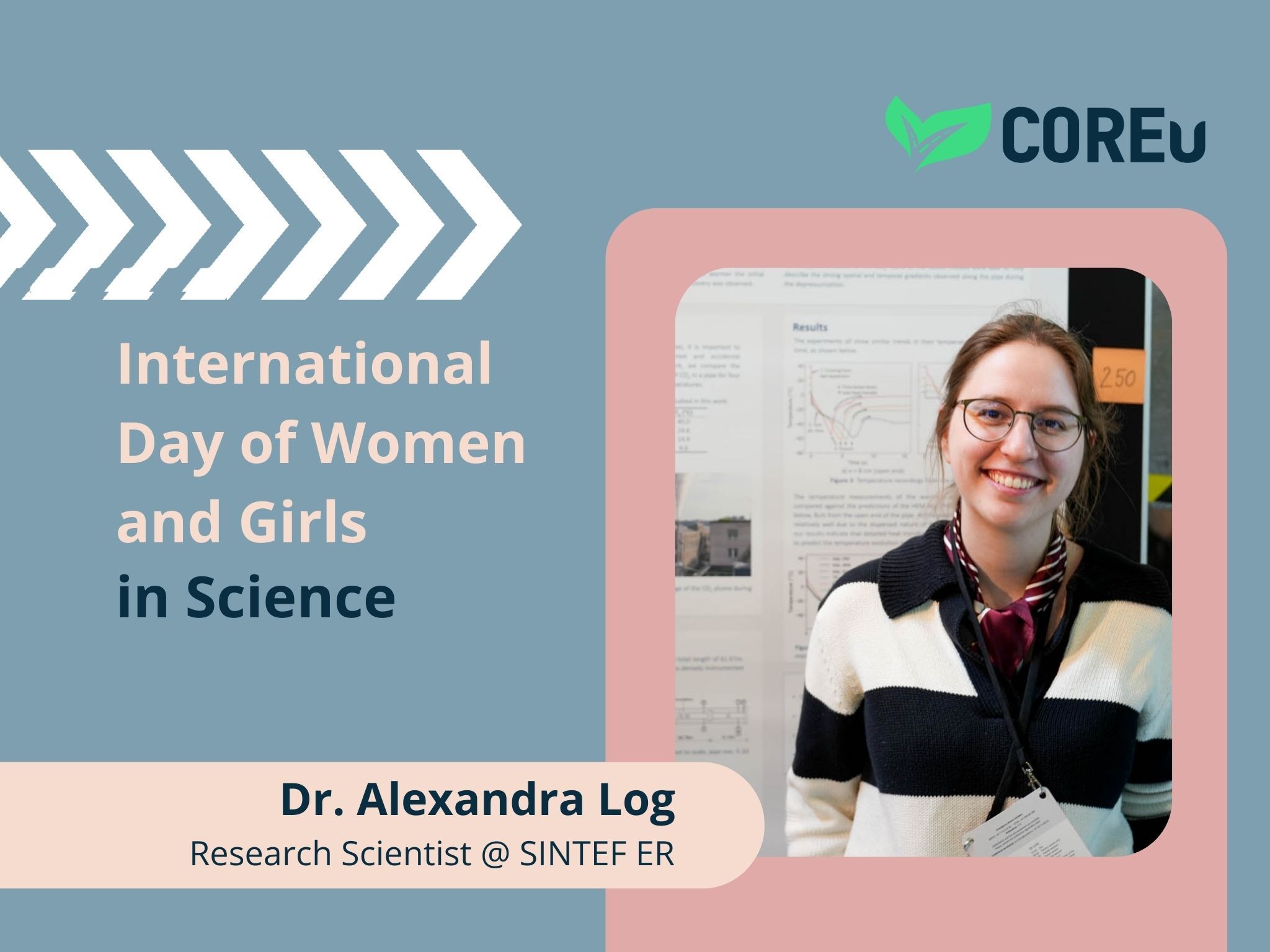
Interview
1. What is your academic background, and how did you decide to pursue a career in STEM?
I have a master’s in physics and mathematics, and a PhD in CO2 flow in pipes. To pursue a career in science came very naturally to me. I’ve always been very curious, and I’ve wanted to understand how the world works. That’s why I chose to study physics and to go into research.
2. What does your work at SINTEF ER involve, and what is your role in COREu?
During my studies, I learned that I really loved doing computer programming, modelling flows, and understanding phase change (like boiling and freezing). At SINTEF ER, I get to work on all those things, so I feel really lucky! In the COREu project, I work on modeling flows for CO2 transport, mainly pipe and well flows. There is so much interesting physics that I get to study while working on these topics, and I am glad that my work can contribute to reducing CO2 emissions in Europe.
3. What challenges have you faced on your journey into STEM, and how did you overcome them?
I haven’t met many challenges on my journey into STEM. It was hard work, but I’ve been encouraged to go into my field, and my curiosity kept me going. However, I can feel a bit lonely sometimes. In many of the meetings I attend now, I am the only woman. My male colleagues are great, but I wish I had more women around me too. I hope more girls and women will find the same curiosity and passion for science as I do. Working on complicated phenomena is so engaging and rewarding.
4. Who are the female role models that have inspired you throughout your education and career?
I was typically inspired by the great men in physics, like Newton and Maxwell and Einstein – maybe because we weren’t taught as much about the great women. In later years, I’ve learned about many women in science who inspire me. I think my favorite must be Emmy Noether. Her work on symmetry and conservation laws is so elegant! I also look up to other women in my field, like Marica Pelanti in France, who works on solving flow equations, and Marcia Huber in the US, who is a developer of the NIST thermodynamics software.