

Women in Science at COREu – Meet Dr. Mabel San Román Niaves
Meet Dr. Mabel San Román Niaves
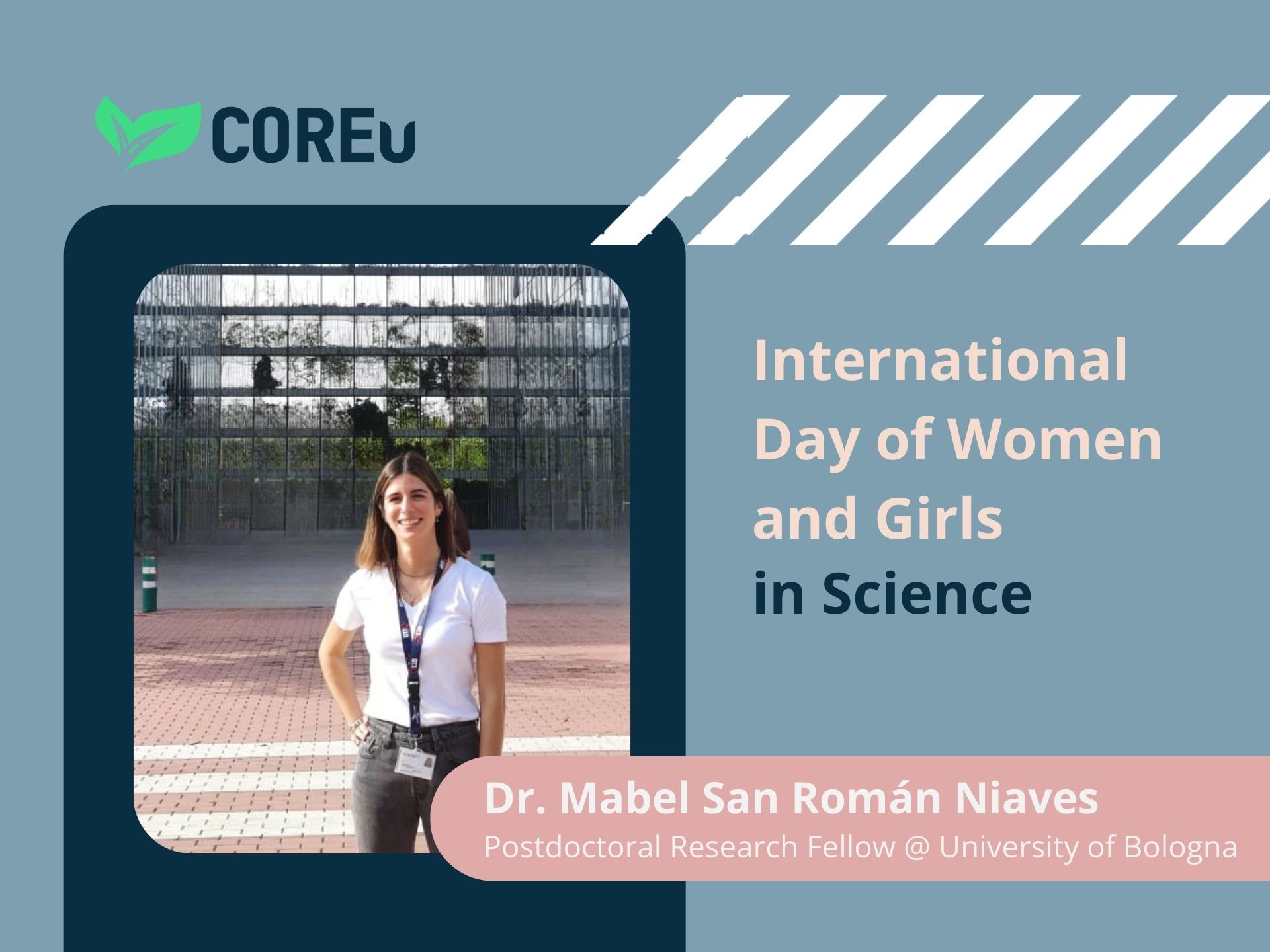
Every year on 11 February, the International Day of Women and Girls in Science celebrates the curiosity, dedication, and impact of women and girls in Science, Technology, Engineering, and Mathematics (STEM). At COREu, we are proud to shine a light on the women whose expertise and commitment are helping to shape a more sustainable future. One of them is Dr. Mabel San Román Niaves, Postdoctoral Research Fellow at the University of Bologna (Unibo). With an academic background in social science, Mabel works at the intersection of human behaviour, technology, and sustainability, contributing essential perspectives to technically complex projects. In this interview, she shares her interdisciplinary journey into STEM, her role in COREu, and the inspirations that drive her research.
Interview
1. What is your academic background, and how did you decide to pursue a career in STEM?
My academic background is in Work and Organizational Psychology. During my studies, I developed a strong interest in how people interact within complex systems, particularly in relation to technology, adaptation processes, work dynamics, and organisational change. Rather than following a conventional STEM pathway, my academic journey naturally evolved towards interdisciplinary research, where the contribution of social sciences is increasingly recognized as essential for enabling technological innovation, integration, and societal acceptance.
My engagement with STEM-related topics began through my involvement in a university research project, which allowed me to explore these dynamics firsthand. What motivated me to work in this field was the opportunity to understand how complex technological projects are developed and implemented, particularly in the context of emerging and sustainable technologies. Being directly involved allowed me to better understand their internal dynamics and challenges, and to observe how **technological innovation can only be effective when human, social, and organizational dimensions are fully taken into account. **This perspective has led me to collaborate closely with engineers, sociologists, biologists, and seismologists, contributing psychological and human-centred insights to technically complex projects.
2. What does your work at Unibo involve, and what is your role in COREu?
At UNIBO, I focus on research activities related to the social acceptance of emerging sustainable technologies, human–technology interaction, and the integration of advanced digital solutions, such as Edge AI in organizational contexts. My work also includes teaching and the dissemination of research findings through scientific publications.
Within COREu, I contribute to the coordination of UNIBO’s social science activities, with a particular focus on social acceptance research, stakeholder engagement, and the analysis of the societal aspects of carbon capture and storage (CCS). This involves the design and implementation of social acceptance studies, including surveys conducted in Greece, the Czech Republic, and Poland. I have also been directly involved in field activities, such as the research visit to Kavala, which provided valuable insight into the local context and stakeholder dynamics. In addition, I contribute to stakeholder mapping that inform engagement strategies, as well as to studies examining perceptions related to employment and job creation linked to CCS.
3. What challenges have you faced on your journey into STEM, and how did you overcome them?
One of the main challenges at the beginning of my journey was transitioning from a primarily social science background to working in highly interdisciplinary and technically oriented contexts. Collaborating with experts from different disciplines requires learning new terminologies, methodologies, and ways of approaching complex problems. At the same time, it offers exposure to new and stimulating perspectives, encouraging continuous learning and opening up different ways of understanding complex issues. Over time, this challenge became an opportunity. Through open communication, curiosity, and a willingness to learn from others, interdisciplinary collaboration gradually became more fluid and effective.
4. Who are the female role models that have inspired you throughout your education and career?
I would not say that my path has been shaped by a single female role model. I have learned by observing different women in academic and professional contexts, each with their own trajectories, working styles, and ways of dealing with challenges. Seeing these diverse experiences has helped me understand that there are multiple ways of building a professional career in different fields, and it has encouraged me to develop my own approach, grounded in curiosity, collaboration, and continuous learning. I deeply admire the many women who have built academic careers while navigating demanding professional environments, often while striving to maintain a balance between professional and personal life. Their everyday persistence and ability to create space for themselves in contexts where women are still a minority have been an important source of motivation for me.